







OVEN NOT BAKING EVENLY: POSSIBLE CAUSES AND FIXES
Your oven allows you to explore endless recipes for entrées, sides and desserts. This can be frustrating, however, if your oven is experiencing issues distributing heat.
This guide covers possible causes and fixes for your oven if it’s not baking evenly, so you can make your favourite meals and expand your culinary horizons without interruption.


HOW TO INSPECT IF AN OVEN IS NOT COOKING EVENLY?
Before scheduling a service appointment, it’s good to check whether your oven’s problem is the result of inadequate heat distribution.
Try these methods to inspect for hot or cold spots in your oven:
Monitor how items cook in your oven
Rotate dishes or adjust the rack positioning.
Keep an eye on whether the heating elements are glowing red hot or if one may not be getting hot enough.
WHY WOULD AN OVEN NOT BAKE EFFECTIVELY?
Here are some of the possible causes preventing an oven from achieving proper heat distribution while baking.
1. A HEATING ELEMENT IS BROKEN
For ovens not distributing heat effectively, the first place to inspect is the heating element. Have a look at the exposed bake and broil elements for breaks or blisters, or any sign of wear.
If your oven’s heating elements are hidden or it turns out that a heating element is affecting your oven’s heat distribution, it’s recommended to schedule an appointment with a licensed professional to troubleshoot and perform any repairs or replacements.
2. THE OVEN WON’T CALIBRATE PROPERLY
An oven that’s not calibrated properly can result in incorrect temperature readings and produce undesirable baking results. If your oven is baking unevenly, inspect it to see if it has been calibrated properly. If it’s not, you will have to recalibrate the appliance.
3. OPENING AN OVEN DOOR TOO OFTEN
An open oven door while baking or roasting food can impact an oven’s internal temperature and produce uneven results. It’s recommended to avoid opening your oven door while it is preheating or baking to maintain the intended bake times and prevent overcooking or undercooking.
Watch this video to learn more about calibrating your appliances.


4. A MALFUNCTIONING TEMPERATURE SENSOR
The temperature sensor monitors the oven cavity and automatically increases or decreases the heat to ensure the right temperature is maintained. This sensor is a thin tube, often made of metal, and can usually be found in the top right corner of the oven’s interior. Even slightly changing the sensor’s position can impact the oven’s ability to distribute heat. If you notice that the sensor is out of position, you can try moving it back to a 90° angle. This may resolve the issue. If repositioning the sensor doesn’t work, it may need to be replaced, or you should inspect your oven’s calibration.
If you are unable to locate the temperature sensor, it’s recommended to schedule a service call.
5. THE AIRFLOW IS RESTRICTED
Covering baking racks or the bottom of your oven with a covering like tinfoil may restrict the airflow inside your oven’s cavity. To promote proper airflow while baking, ensure that your oven racks and the bottom of your oven are free of obstructions.
6. OVERCROWDED OVEN RACKS
An oven can only cook food evenly and effectively if it can circulate hot air throughout the cavity. By overcrowding the racks, you prevent hot air from accessing all of the food’s surface area. It’s recommended to allow a minimum of two inches of space around pans to achieve desirable results.


HOW TO FIX AN OVEN THAT’S NOT BAKING EFFECTIVELY
Determining the right way to fix your oven’s heating issue depends on the cause. Several causes, like restricted airflow and overcrowded racks, can be chalked up to user error and be resolved with relative ease. Incidentally, if your oven needs repairs, it may be best to contact a licensed technician.
If you suspect that your KitchenAid® oven needs to be repaired or requires a replacement part, contact the help desk to speak to a representative and schedule a service appointment.
TRY TO RESIST OPENING THE OVEN DOOR WHILE BAKING
Ovens are designed to bake, broil and roast by heating the cavity with gas flames or an electric heating element. If you open the oven door during the cooking process, you are allowing the heat to escape, which would decrease the temperature and extend the cooking times.
It’s important to monitor your food as it cooks, but you should do so without opening the oven door. Use the oven’s interior light to see through the window to check where your food is in the baking process.


EXPLORE KITCHENAID® OVENS
If you want to replace your oven or upgrade your kitchen, KitchenAid brand offers a suite of wall ovens. Explore single and double-wall ovens equipped with features on select models like Even-Heat™ Preheat, to help ensure cold spots don’t occur in your oven’s cavity, and Even-Heat™ True Convection, which circulates hot air throughout the oven cavity to help produce even baking.
APPRENEZ-EN PLUS SUR LES FOURS DE LA MARQUE KITCHENAID
-
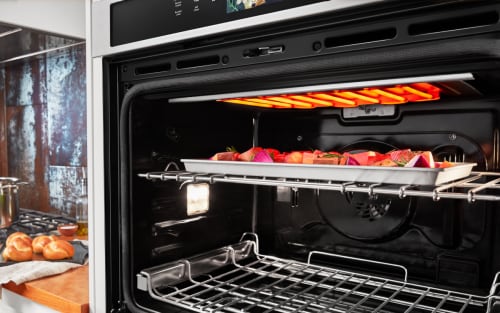 Guide to Air Frying in a Convection Oven Discover the benefits of air frying in a convection oven and how to get the most out of this method. Plus, learn convection oven air fryer recipes.
 -
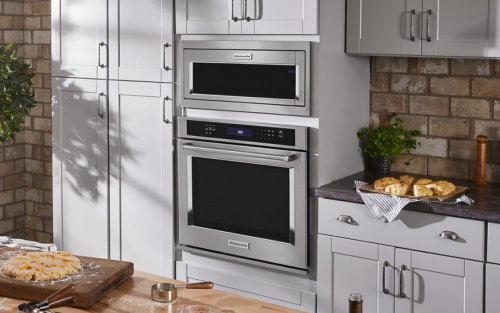 Understanding Ovens: How Different Types Cook Your Food Explore oven types, their cooking mechanisms, and settings to enhance your culinary skills and achieve delicious results in the kitchen.
 -
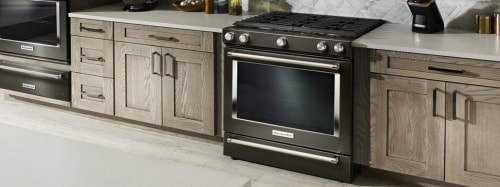 4 Simple Steps to Effectively Clean Your Self-Cleaning Oven Explore our guide to using your self-cleaning oven, including tips, FAQs, and step-by-step instructions.

