New Code Sent!

Does stainless steel work on induction cooktops?
Thanks to its versatility, even heat distribution, and durability, stainless steel cookware is a popular choice for home cooks and professional chefs. With the growing popularity of induction cooktops, including those from KitchenAid brand, you may be asking if your stainless steel cookware is compatible with these types of cooking surfaces.
Induction cooking is designed with a copper coil under a ceramic-glass surface. It generates an electromagnetic charge that reacts with magnetic cookware, meaning it generates heat directly within pots and pans, rather than from the coil. You need to use a pan equipped with a ferromagnetic base to conduct the heat, which means it must contain iron content or a layer with magnetic properties.
Keep reading to learn more about stainless steel cookware, how to test for compatibility, and the benefits of induction cooking cookware.


Does stainless steel work on induction?
Generally speaking, stainless steel will work on an induction cooktop, but there is a catch: a compatible pan must be built with a magnetic base. Luckily, you can test any pan with a magnet to confirm if it will work on an induction cooktop.
Remember, not all stainless steel pans are induction compatible. This type of cookware will work if it is made entirely of, or contains, a layer of magnetic materials. However, there are many types of stainless steel, each made with its own combination of metals and featuring a collection of layers. These various combinations may impact the quantity of magnetic content and the pan’s conductivity and compatibility with an induction cooktop.
You’ll find that with stainless steel pans, there are different grades of stainless steel, which can negatively impact induction compatibility or performance. You should understand which grade of stainless steel your pan is made from, as stainless steel features a high nickel content, which can block the magnetic field, resulting in the pan being undetectable by the element.


Stainless steel types:
200 Series: Usually found in cheaper, lower-quality cookware, this type of stainless steel is typically not magnetic or induction-compatible.
300 Series: This type is the most common, and includes the 304 and 316 series, also known as the 18/8 and 18/10. They are often more durable and corrosion-resistant, but typically nonmagnetic.
- 400 Series: This type is the most common, and includes the 304 and 316 series, also known as the 18/8 and 18/10. They are often more durable and corrosion-resistant, but typically nonmagnetic.
Furthermore, some stainless steel pans are labeled 3- or 5-ply, meaning they’re constructed in layers. The first layer is comprised of core material, whereas the rest are the stainless layers wrapped around it. If durability matters to you, then consider that 5-ply can be far more durable than a 3-ply pan.


How to confirm if your stainless steel cookware is compatible with induction
You can confirm if your pan is induction compatible with a magnet. If the magnet sticks securely to the bottom of the pan, it is safe for induction cooking. However, if the attraction is weak or non-existent, the pan is most likely not a great option for an induction cooktop.
Tip:
Some cookware has an induction-compatible symbol on the bottom of the pan. These are often zig-zags or coils, or the pan may have the word “induction” on it.
Which cookware is ideal for induction cooking?
When selecting induction-compatible cookware, choose materials like cast iron, magnetic stainless steel, or enameled cast iron. Always avoid aluminum, glass, and copper.
Let’s review the different types of cookware:
Stainless steel: This material is durable and versatile, but you must test each piece to confirm if it’s magnetic and compatible with an induction cooktop.
Carbon steel: Made of a combination of carbon and iron, this cookware is often highly electromagnetic and typically compatible with induction cooktops.
Cast iron: Cast iron is durable and conducts heat slowly yet retains it for a long time. While these pans are compatible with induction cooktops, it’s best to choose one with a smooth bottom, as rough cast iron may scratch a cooking surface.
- Aluminum, all-copper and glass: These materials are not usually compatible with induction, but the one exception is if they are built with a layer of magnetic material on the bottom.
Porcelain enamel on metal: This material will work on induction, but only if the base metal is magnetic. Always perform the magnet test with this type of pan.

KitchenAid® Induction Downdraft Cooktops
Fast and powerful extraction to help clear the air
Downdraft ventilation adjusts automatically to remove steam, odours, and smoke 5x faster than steam can rise.

KitchenAid® Hardware Accessory Kits
Curate the textures and colours that inspire awe
From bold Black Ore to the warmth of Bronze, mix and match handles and knobs to reinvigorate your appliances and breathe new energy into your kitchen.
Explore More with KitchenAid Brand
-
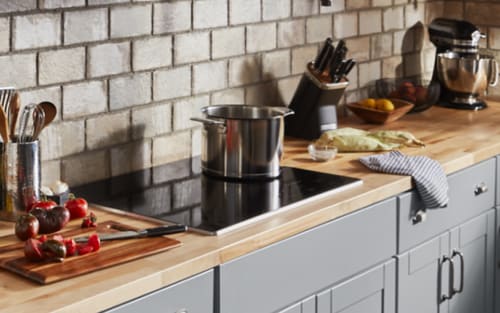 5 Steps to Clean an Induction Cooktop - Get a Spotless Cooktop Use these 5 simple steps to clean your induction cooktop. Learn why you should use affresh® glass and ceramic cooktop cleaner for stuck-on messes.
 -
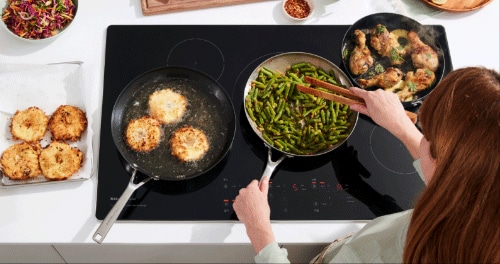 Induction vs. Electric Cooktops Learn about induction vs. electric cooktops with this guide from Whirlpool®. Explore how an induction cooktop works, compatible materials and more.
 -
 Everything You Need to Know About Induction Cooktops Discover what has made induction cooking so popular in recent years. Learn how it works, the pros, cons, which cookware is compatible & more.