New Code Sent!

TIPS TO MAXIMIZE OVEN SPACE AND COOK MULTIPLE DISHES
When you’re prepping to serve multi-course meals for large gatherings and holiday festivities, it can be challenging to balance everything from cook times to temperatures. You have to be adept at juggling multiple dishes, which are all competing for space in the same oven.
Don’t worry, we’re here to help. Use the eight tips provided in this article to maximize oven space, so you can focus on the joy of creating and not have to remove a dish from your menu at the last second because it didn’t have enough time to cook.


8 TIPS FOR MAXIMIZING OVEN SPACE
Before getting into it, it’s important to understand a few things:
Oven hot spots
Rack positions
Oven settings
These functions and elements of your oven will help you create a large spread of appetizers, entrees, sides, and desserts.
Now it’s time to review some helpful tips, so you can plan meals, prep ingredients, adjust racks, position dishes, and alter cooking times as needed to cook multiple dishes at once, regardless of your oven’s size.

1. PREP IN ADVANCE
Not all dishes need to be baked on the day they’re going to be served. Most pies, for instance, can be made ahead of time and then reheated before serving. Review your recipes to determine if any dishes can be baked in advance.

2. PLAN AHEAD
Once you’ve settled on your recipes, you need to make a concrete plan to ensure every dish is properly cooked for mealtime.
The first step to planning any multi-course meal is to determine when you want food ready to eat. Then, work backward from there to determine what needs oven space, how much space is needed, and when it must start cooking. You may want to cook baked goods or dishes that need less time to cook and time to rest first, then move on to dishes like meats that often require more cooking times.
You also must plan for dishes that need a quick rewarming or a brief broil before serving.

3. USE THE AVERAGE TEMPERATURE
Cooking multiple dishes at once often means putting entrees, sides, and desserts in the oven at the same time, even if they cook at different temperatures. Most people don’t realize that you can bake several dishes at once by setting your oven to the average recommended temperature across recipes. For instance, if one dish cooks at a temperature of 350℉ and another at 400℉, set the temperature to 375℉. What’s important here is to monitor each dish closely as it cooks to ensure it doesn’t burn or end up being undercooked, for when you want to serve it.
Remember, baked goods and other recipes that rely on precise cooking temperatures must be baked according to the recipe’s recommended temperature. Using a double oven like the double wall ovens from KitchenAid brand gives you the freedom to manage multiple cook times and temperatures to create extravagant meals in one shot. You can create even more using a KitchenAid® countertop oven with select models equipped with settings your main oven may not have, such as convection cooking, air frying, and proofing for bread dough.

4. ALLOW ROOM FOR AIR CIRCULATION
Ovens require hot air circulation to thoroughly cook dishes. This means that dishes that are situated too close together on racks may prevent food from achieving an even cook. It’s best to leave a couple of inches between dishes and another couple of inches between the dishes and the oven wall, ensuring that no bakeware overlaps. Also, make sure that no two dishes are directly above or beneath each other.

5. CONSIDER OTHER APPLIANCES
You may have other appliances capable of prepping ingredients for your meal. If possible, consider using a convection cooking setting like the one on these KitchenAid® microwaves to bake dishes similar to how an oven would, or crisp and brown foods with an air fryer or air fry setting like the one on select KitchenAid® countertop ovens. Select models usually have 9–12 settings for common cooking techniques, which can free up oven space, including but not limited to:
Broiling
Roasting
Baking
Proofing dough

6. ROTATE DISHES
Conventional ovens employ radiant heat generated from the elements at the top and bottom of the oven cavity. This is why dishes closer to an element will potentially cook faster. Some ovens may also get hotter near the back, where heat has less time and opportunity to escape when the door opens.
A smart tip is to rotate dishes from front to back and between the top and bottom racks to help them cook as evenly as possible.

7. USE A BROILER TO REDUCE PREHEATING TIME
Skipping the preheating stage isn’t always ideal, but you can start cooking faster by using your broiler to reduce the oven’s preheating time. Simply set the oven to broil for 3 to 5 minutes, then change the settings to the required baking temperature. This may be able to reduce the overall time it takes for your oven to heat to the desired baking temperatures.
Keep in mind that using the broiler to preheat may result in uneven heat in the oven. It’s best to only use this method with meats or frozen foods when necessary, and avoid it for delicate or fresh dishes.

8. USE CONVECTION SETTINGS
Ovens with a convection cooking function work by circulating hot air throughout the cavity in an effort to reduce moisture and allow the food on different racks to cook evenly. Try cooking dishes using a convection setting, as this will promote even heating across racks and help reduce the moisture that can be introduced when cooking several dishes at once. Additionally, the even heat circulation of convection cooking makes rotating dishes unnecessary to achieve evenly baked results.
Often overlooked is that some recipes may be written for conventional ovens. In this case, you must check for instructions for converting to convection cooking. Generally, you should lower the cooking temperature by 25°F and check for doneness with 20-25% of the time remaining. Select KitchenAid® ovens come with the EasyConvect™ Conversion System, which automatically converts conventional settings into convection cooking settings.
SHOP KITCHENAID® WALL OVENS
KitchenAid® wall ovens let you explore freely in the kitchen, no matter how many dishes you’re creating. KitchenAid® double ovens provide two oven cavities, allowing you to give every dish the temperature, time, and space it needs to cook evenly and properly. Select ovens feature Even-Heat™ True Convection that circulates hot air throughout the oven, promoting airflow and optimal temperatures to crisp, bake, flake, caramelize, or brown food to your liking.


DO THE TOP OR BOTTOM OF THE OVEN COOK QUICKER?
The interior of a conventional oven often has heating elements on the top and bottom. Since hot air rises inside the cavity, food tends to get hotter and cook quicker on the top rack.
When cooking multiple dishes, ones that require longer cooking times should be placed on the top rack. This is less important when using a convection setting, which helps circulate air to achieve even cooking across racks.


IS A HIGHER OR LOWER SHELF BETTER IN AN OVEN?
The ideal oven rack position should be based on what you’re cooking. In a conventional oven, putting the rack in the top third of the oven may help cook food faster and works well for browning, toasting, broiling, or crisping dishes. Incidentally, placing the rack on the bottom third of the oven is ideal for baking, roasting, or getting a crust to form on a loaf of bread or a pie.
A convection oven helps cook dishes evenly across racks, so placement doesn’t have to be a priority for most recipes that call for baking and roasting.


DOES HAVING MORE TRAYS IN THE OVEN CAUSE ITEMS TO COOK LONGER?
Generally, cooking multiple dishes at once can result in longer cooking times. However, the exact impact on cooking times varies based on what you’re cooking. You should always leave at least 3 inches of space between each dish and the walls of the oven, or other dishes, to allow for the air to circulate freely within the oven cavity.


HOW DO YOU ADJUST COOKING TIME FOR MULTIPLE DISHES IN THE OVEN AT ONCE?
Cooking multiple items at the same time often results in dishes having to spend roughly 15 percent longer in the oven. That said, you will need to monitor each dish for browning and doneness throughout the process.
EXPLORE KITCHENAID® WALL OVENS
Built-in wall ovens from KitchenAid brand come in single, double, or combination configurations, giving you the space to create whatever you wish. Select wall ovens are equipped with Even-Heat™ True Convection, which circulates hot air throughout the entire oven for consistent temperatures. Some models have the EasyConvect™ Conversion System, which is designed to automatically adjust conventional baking temperatures to convection equivalents, removing the guesswork
LEARN MORE ABOUT OVENS WITH KITCHENAID BRAND
-
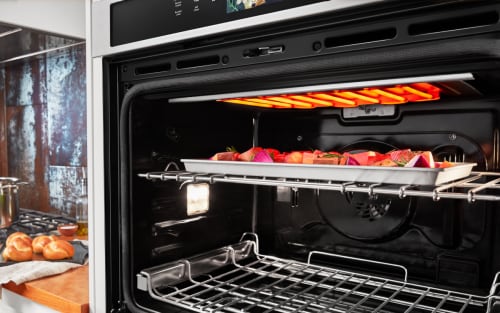 Guide to Air Frying in a Convection Oven Discover the benefits of air frying in a convection oven and how to get the most out of this method. Plus, learn convection oven air fryer recipes.
 -
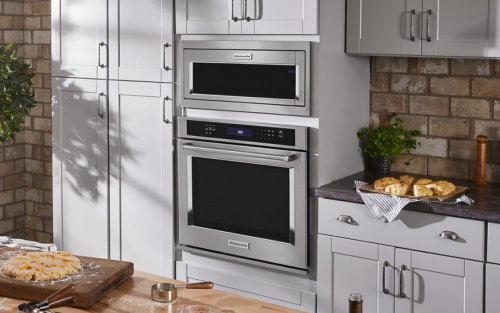 Understanding Ovens: How Different Types Cook Your Food Explore oven types, their cooking mechanisms, and settings to enhance your culinary skills and achieve delicious results in the kitchen.
 -
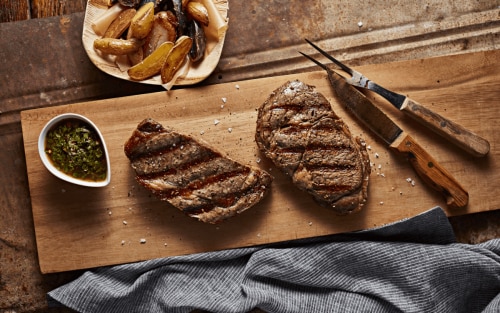 How to Grill in Your Oven Discover the tricks to grilling in the oven, including how to grill meat and vegetables. Explore tips for using an oven as a grill and try these oven grill recipes.